0 Comments
 A trailer wheel rolling past the van while leaving the HQ was not the best omen with which to start a race weekend - but luckily the OUMF race team is not superstitious! Attempt 2 to leave went much more smoothly, and the team made their way north-east to the very technical Snetterton 300 race circuit in Norfolk. The team had just returned from Belgium the previous weekend, where we had scored a notable success with a Class win with our rally Riley 1.5 in the FIA Ardeca Ypres Rally. Almost as soon as we got off the DFDS ferry, we had continued the race prep our 1959 Elva Courier, in the hope of running it at Snetterton 5 days later. While it was quite the valiant effort to try and get the ol’ girl ‘good to race’, it was eventually decided to put a much less time-constrained effort in on the car after Snetterton. This meant the team fully committed to taking our Sebring Sprite and Riley 1.5 racers, our tried and tested machines which only required a quick refresh instead of a full buildup!
On reaching the circuit near Norwich, we set up our pit at the track and then made our way to the pub for some grub. However, after previous all-nighter of race prep took its toll on many of the team, and upon our return to the track, a rare occurrence took place…the exhausted OUMF’s were all in bed by 22:00!
The OUMF team’s plan was to leave on the afternoon of Saturday 29th July for Oulton Park’s signature Gold Cup, as our race in the Riley - The Jack Sears Trophy - was on Sunday 30th July…or so we thought until 1pm on the Friday afternoon! At that point it was realised that the race was ACTUALLY on Saturday 29th! Now most of you, I’m sure, might say that once the simple mistake is realised, it's an easy fix: ‘just’ pack and leave immediately for the circuit, right? Well, yes, but at this point the team was heading out to collect a semi-dismantled TVR Wedge that had been
Those of you who have been following OUMF recently will have seen that we now have a current project in the form of a Riley Kestrel. This has been on display to the public at the NEC Classic Motor Show in November 2022, and many will have seen it in a particularly sorry state… body panels missing, half painted, no interior - the list of things that were missing or badly damaged was probably longer than the list of what was present. Some of you may wonder, what prompted this departure from the dedicated competition car projects to date, and where did this car come from?
However, before I address these questions, I should first say that – possibly to the surprise of many - this wasn’t how we got it, even though it was fully running and driving when it arrived! So, how on earth did the car end up in the state that is in now? The problem that we had with the 1968 Riley Kestrel project arose only after painting the interior of the shell and then comprehensively lining the floor, doors, and other panels with a sound-deadening product called Kilmat. This is a butyl rubber backed foil, similar to other products like Dynamat, and is a dense, malleable sheet - very like the bitumen panels found on older cars - that absorbs drumming, and drivetrain and road noise very effectively. Once the lengthy process of cutting it to shape, sticking it down, and thoroughly rolling it into place is completed, it is extremely difficult and very messy to remove. The Kestrel came to us following extensive renovation of the floor, including replacement of the sills and much of the floorpan. We stripped the floor inside back to bare metal and it was very sound prior to painting with Rustbuster epoxy mastic , and top coat in body colour. The underside had been finished with a coating of black ‘schutz’ type underseal which was lavishly applied and did not appear to need further attention - all of which gave us the confidence to apply the Kilmat.
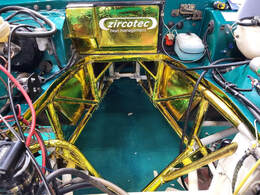
It was at this point that two issues arose in quick succession. The first was that we were kindly donated an LCB manifold and pipework by John Ashley Exhausts, and Joe Ellis at BTB Exhausts generously offered to help by undertaking various modifications in the course of making it fit as snugly along the underside of the car as he could. His artistry resulted in there being very little clearance between the stainless steel silencer boxes and the walls of the tunnel - which looked fantastic, but spelled big trouble for the very meltable Kilmat now glued just above it. The second problem was the chance discovery that the schutz underseal had been applied to bare steel – without any signs of... My arms are sore, it’s cramped, and for gosh sake, this underseal does not come off easily!
Firstly, I’d like to take a moment to say a big thank you to all of our sponsors and the individuals who made this week possible. Without you, this would not have been feasible and we are all better off for experiencing this opportunity.
Firstly, I’d like to take a moment to say a big thank you to all of our sponsors and the individuals who made this week possible. Without you, this would not have been feasible and we are all better off for experiencing this opportunity.
Sunday The start of action week began on Sunday the 8th of January. We converged at the barn at 11am to begin preparation in order for the week to run as smoothly as possible. Now I must say we were extremely productive and put our engineering minds to the best of use: we invented crutch cricket and kicked an increasingly muddy football around whilst we waited for Ding to get some PayPal issues sorted out with the help of Bobby Bragg. Whilst our own, slightly disorganised, version of the OUMF Olympics was underway we sporadically packed up Ding’s Volvo with the engine blocks that were going to go through the baths at Lenton Treatments, packed laminates of the sprite and team photos that had been lovingly signed by all the team taking part in Action Week and packed all the teams personal kit. It was a struggle, but somehow we managed to fit all 10 of us into two cars, plus the kit and the engine castings. In Bobby’s car was Marcus Ward, Arran McLuskie, Archie Stewart and myself. In Ding’s car were Seb Paul, Luis Albas, Eddie Scheer and Sean Harvey. Luckily for us, Ollie Raja-Brown would be meeting us at Fuchs Lubricants the following morning so that there would be space for Joe Taylor, and all our kit to be distributed between the three cars. The drive to the Taylors home in Congleton was mostly uneventful though we now have learnt not to trust Bobby’s navigational skills, with him leading us away from the right destination even though everyone in the car saw Ding take the right turning. ‘Surely he’s going the wrong way?’ No, he went the right way, although we did get a more scenic route seeing all that Congleton town had to offer. Roughly 15 minutes behind Ding the second car arrived and we were shown around Joe’s home. A very warm thanks to the generosity of Joe’s parents for letting all of us stay. They kindly put us up in the garage which had been converted into... Welcome to the latest OUMF update - and the most important news is that we are still going! -
despite the best efforts of Covid, Putin, and the economic downturn to kybosh this amazingly resilient & resourceful student initiative. This edition of the OUMF Newsletter reflects one pithy bit of feedback about previous ones: “Nobody wants to read a telephone directory of thanks you’s. We all know you’re grateful! Just give us the highlights – and make it snappy!” Wise advice, acted on, and we hope you enjoy the shorter, clearer, more digestible result! If your appetite is not appeased, and you find yourself hungry for more, please see our OUMF website for further news, detailed race reports, great photos, the roll of our many great supporters, and much more. So here goes… Silverstone Grand Prix Circuit |